Ekaterina Svikhnushina

About me
Since December 2023, I have been the Technical Cooperation Manager at Huawei’s Zurich Research Center. In this role, I play a crucial part in facilitating R&D initiatives, driving innovation, and fostering strategic collaborations for significant technological advancements. Before this, I earned a PhD in Computer Science from EPFL, where I worked with Pearl Pu on social conversational agents, commonly known as chatbots. I hold master’s and bachelor’s degrees in applied mathematics and physics from MIPT.
I am passionate about human-computer interaction, user experience, and artificial intelligence. My PhD research focused on understanding what qualities make chatbots compelling to users, and how to evaluate them. To achieve this, I approached my work from a user-centered perspective, focusing on theoretical conceptualization, experimental design, and evaluation. Thanks to my interdisciplinary background, I have a unique set of skills that allows me to collaborate effectively with professionals from various fields.
Research and Projects Summary
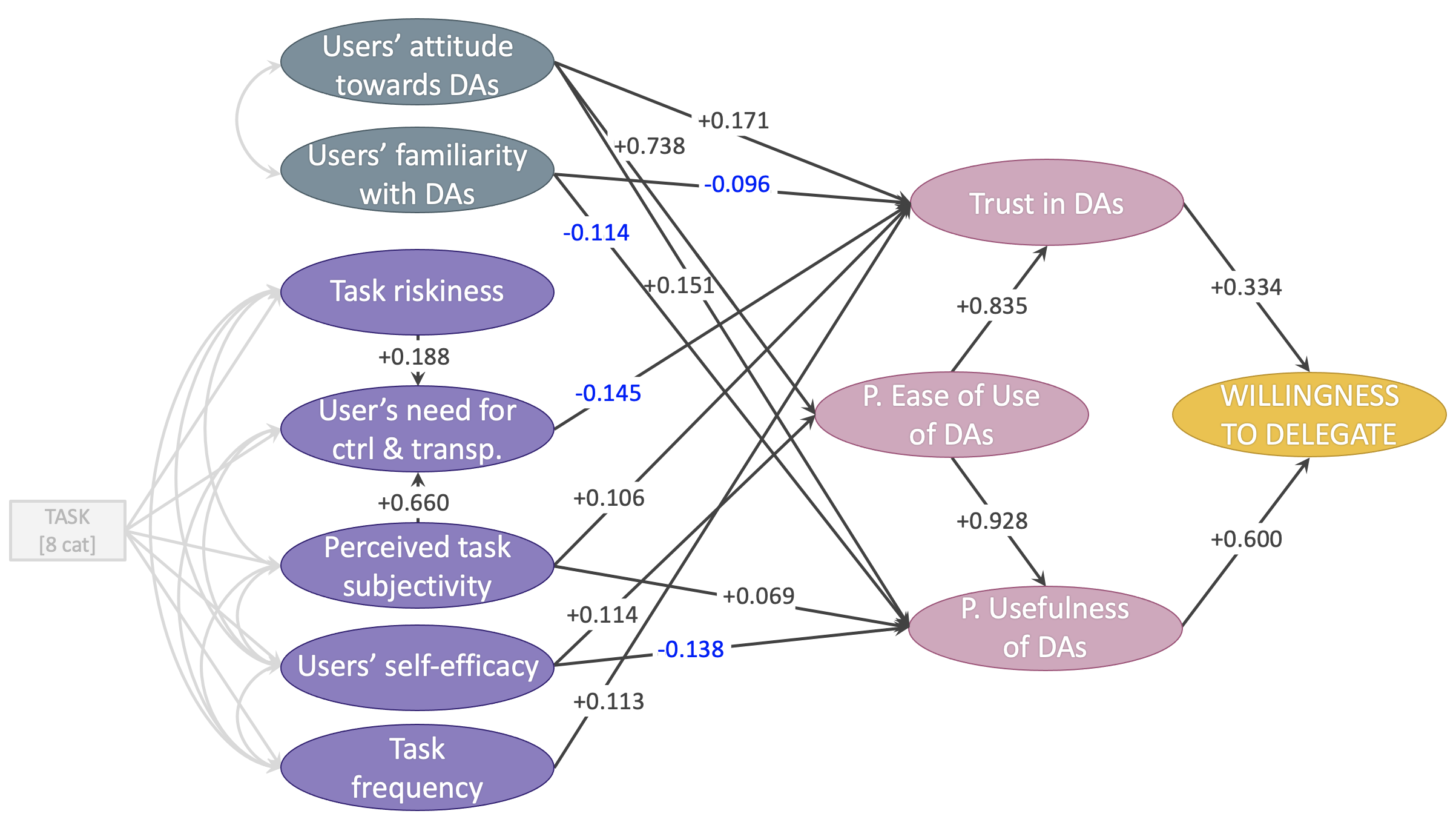
Expectation vs Reality in Users’ Willingness to Delegate to Digital Assistants
Keywords: SEM, survey, digital assistant, willingness to delegate, trust, technology adoption, expectations
Publication: CHI’2023, QuantUXCon’2023 (to appear), EAM’2023 (to appear)
Talk: https://youtu.be/Lgk2bBXRnsQ
We investigated drivers of willingness to use Digital Assistants (DAs) to complete various tasks. Drawing on related research on technology adoption, decision delegation, and automation, we conceptualized a model comprising key determinants of willingness to delegate, focusing on infuenceable factors for practitioners. This model includes users’ perceptions of different tasks, of DAs, and of their value (specifcally trust, ease of use, and usefulness). Our psychometric evaluation procedure confrmed the validity and reliability of the constructs in our model and verifed that the paths between them represented meaningful relationships. We interpreted these findings in light of related work and derived implications for practitioners.
Approximating Human Evaluation of Social Chatbots with Prompting
Keywords: prompting, LLM, GPT-3.5, online interactive evaluation, chatbots, calibration
Preprint: arXiv’2023
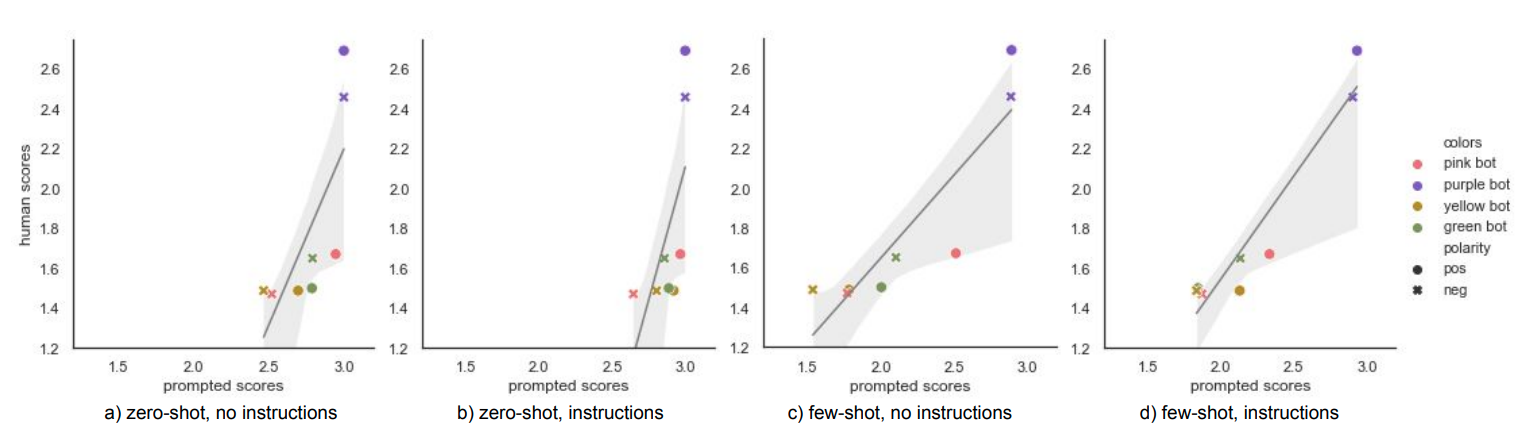
The project addresses the need for scalable and robust evaluation metrics for conversational chatbots, as existing automatic evaluation metrics often focus on objective quality measures and disregard subjective perceptions of social dimensions. We proposed a framework that uses large language models (LLMs) from the GPT-family to collect synthetic chat logs of evaluated bots and conducts dialog system evaluation with prompting. The framework achieves full automation of the evaluation pipeline and shows impressive correlation with human judgement. The best-performing prompts include few-shot demonstrations and instructions, demonstrating the ability to generalize to other dialog corpora.
iEval: Interactive Evaluation Framework for Open-Domain Empathetic Chatbots
Keywords: interactive human evaluation, empathetic chatbots, ANOVA, interaction effects, discourse analysis
Publication: SIGDIAL’2022
Talk: https://youtu.be/WHxqN4MgvAA
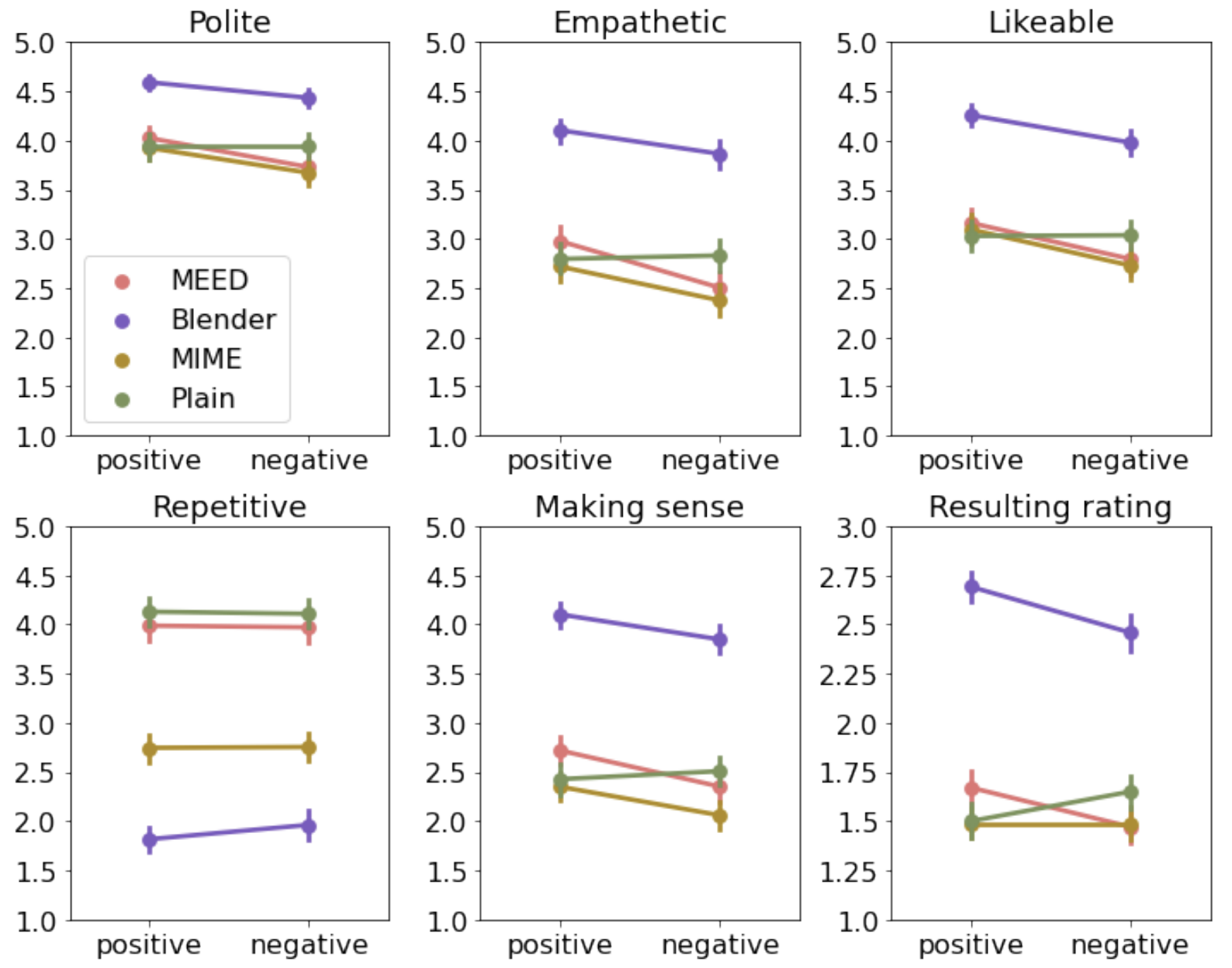
In this project, we proposed an interactive human evaluation framework called iEval, which measures the performance of open-domain empathetic chatbots. iEval framework provides high consitency in curated scores of subjective perceptions of chatbots as both the emotional interaction and evaluation of a chatbot are accomplished by the same human actor. The framework is used to benchmark several state-of-the-art empathetic chatbots and discover intricate details in their performance in different emotional contexts, leading to key implications for further improvement of such chatbots.
A Taxonomy of Empathetic Questions in Social Dialogs
Keywords: taxonomy, crowd-sourced annotation, automatic classification, BERT, visualization
Publication: ACL’2022
Talk: https://underline.io/lecture/49668-a-taxonomy-of-empathetic-questions-in-social-dialogs
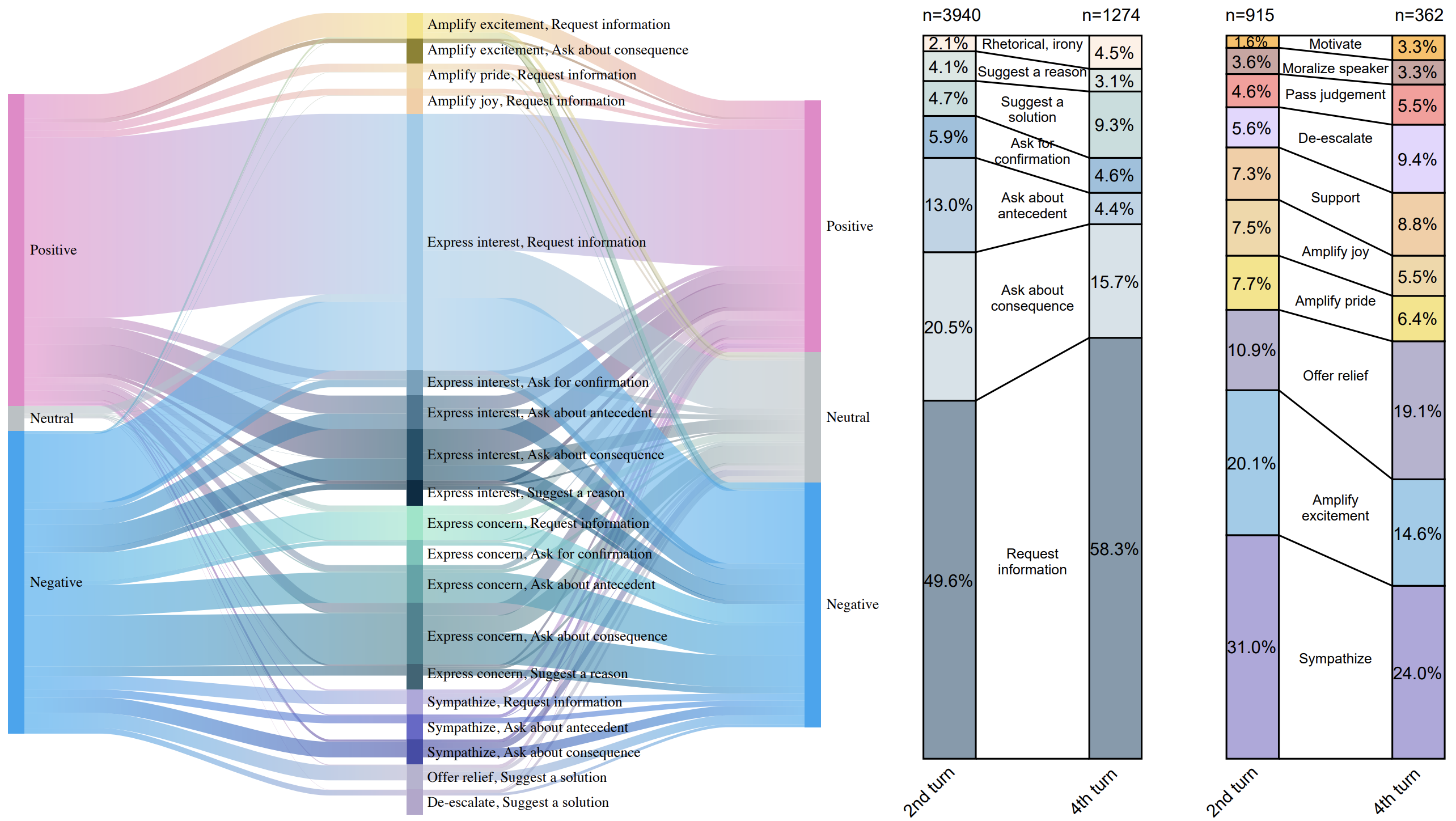
We took a step towards improving conversational chatbots’ question-asking abilities by developing an empathetic question taxonomy (EQT) that captures the communicative acts and emotion-regulation intents of questions in social dialogs. To operationalize the taxonomy, we used a crowd-sourcing task to annotate a large subset of the EmpatheticDialogues dataset and further developed automatic labeling tools using the annotated data. Information visualization techniques were employed to summarize co-occurrences of question acts and intents and their role in regulating interlocutor’s emotions, revealing important question-asking strategies in social dialogs.
User Expectations of Conversational Chatbots Based on Online Reviews
Keywords: mixed-method study, online reviews, content analysis, sentiment analysis, regression, topic analysis, thematic analysis
Publication: DIS’2021
Talk: https://youtu.be/GlnW-Fuo5BA (by my student)
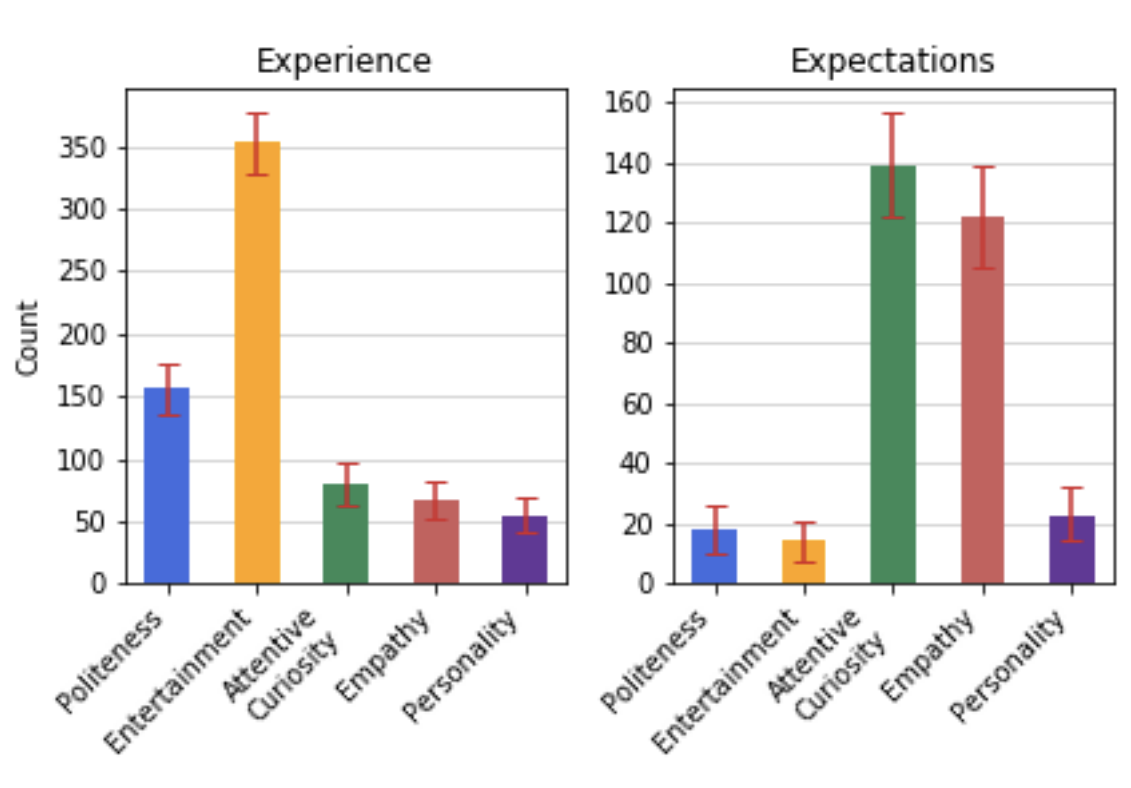
Drawing from reviews of chatbots posted on Google Play, we explored user experience and expectations of these agents in a mixed-method study. Results of statistical analysis revealed which social qualities of chatbots are the most significant for user satisfaction. Further, we employed natural language processing and qualitative methods to identify how users wish their chatbots to evolve in the future. While currently users mostly value the entertaining component of their experience, their expectations call for more human-like behavior of chatbots. The most prominent expectations include chatbots’ abilities to treat and express emotions and be more attentive to the user. Based on these findings, we derived design implications, discussing the directions for developing social skills of open-domain chatbots.
PEACE: A Model of Key Social and Emotional Qualities of Conversational Chatbots
Keywords: semi-structured interviews, survey, emotional intelligence, social intelligence, adoption, SEM
Publication: IUI’2021 and TiiS’2022
Talk: https://youtu.be/DAk99Id9Vt0
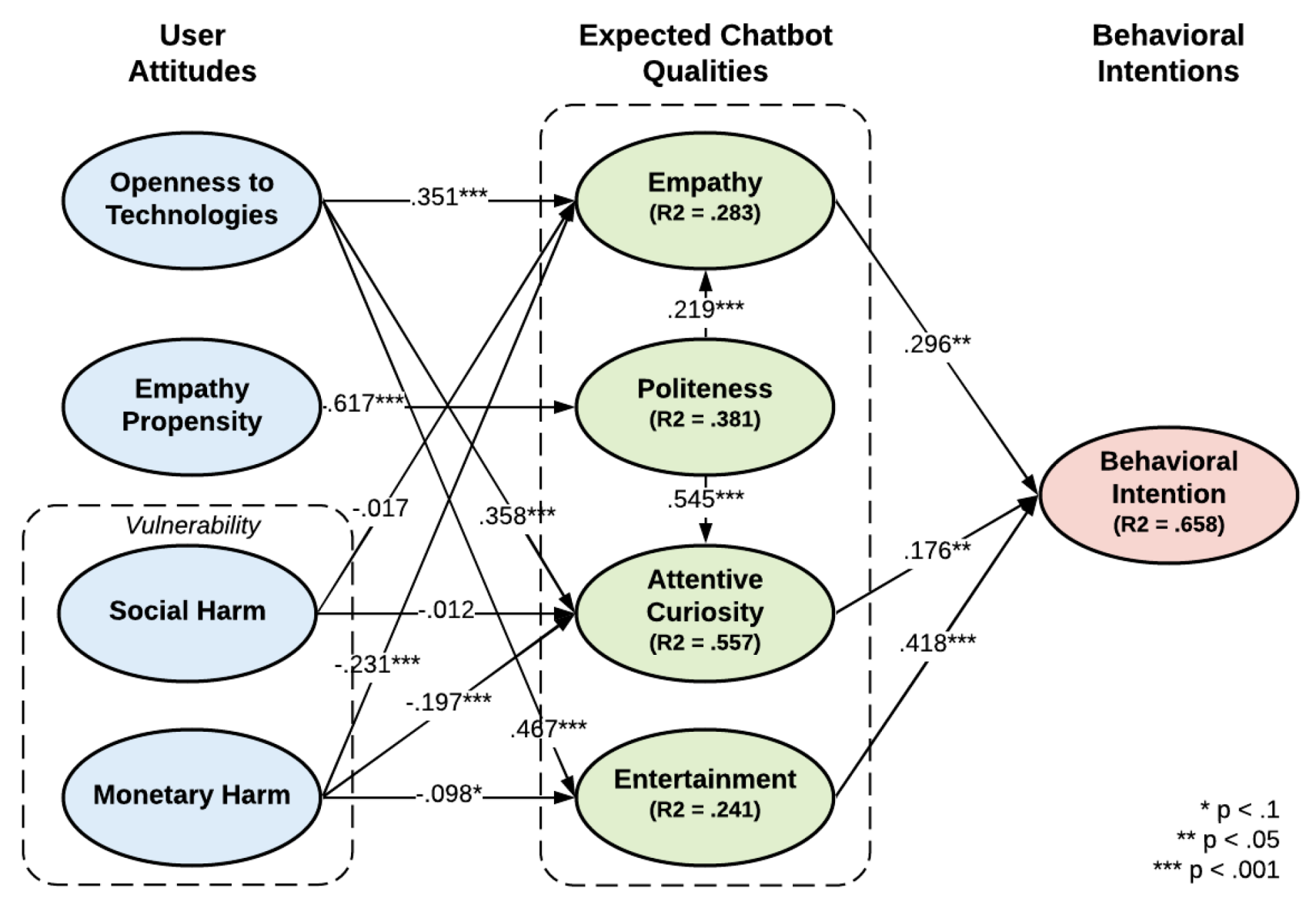
We aimed at devising a holistic model of social and emotional qualities that users expect from their chatbots. We conducted an exploratory user study to understand the desired qualities of chatbots with a special focus on their emotional intelligence. Further, we developed a model of the desired traits, called the PEACE model (Politeness, Entertainment, Attentive Curiosity, and Empathy), and validated it through a large-scale survey and structural equation modeling. The study sheds light on the importance of and interplay between the chatbots’ qualities and the effect of users’ attitudes and concerns on their expectations of the technology, and provides design implications for the development of socially adequate and emotionally aware open-domain chatbots.
COVER: Make volunteering services easily accessible for risk groups
Keywords: dialogflow, fluid-ui, javascript, python, voximplant, call service
Project page: https://devpost.com/software/cover-proposal
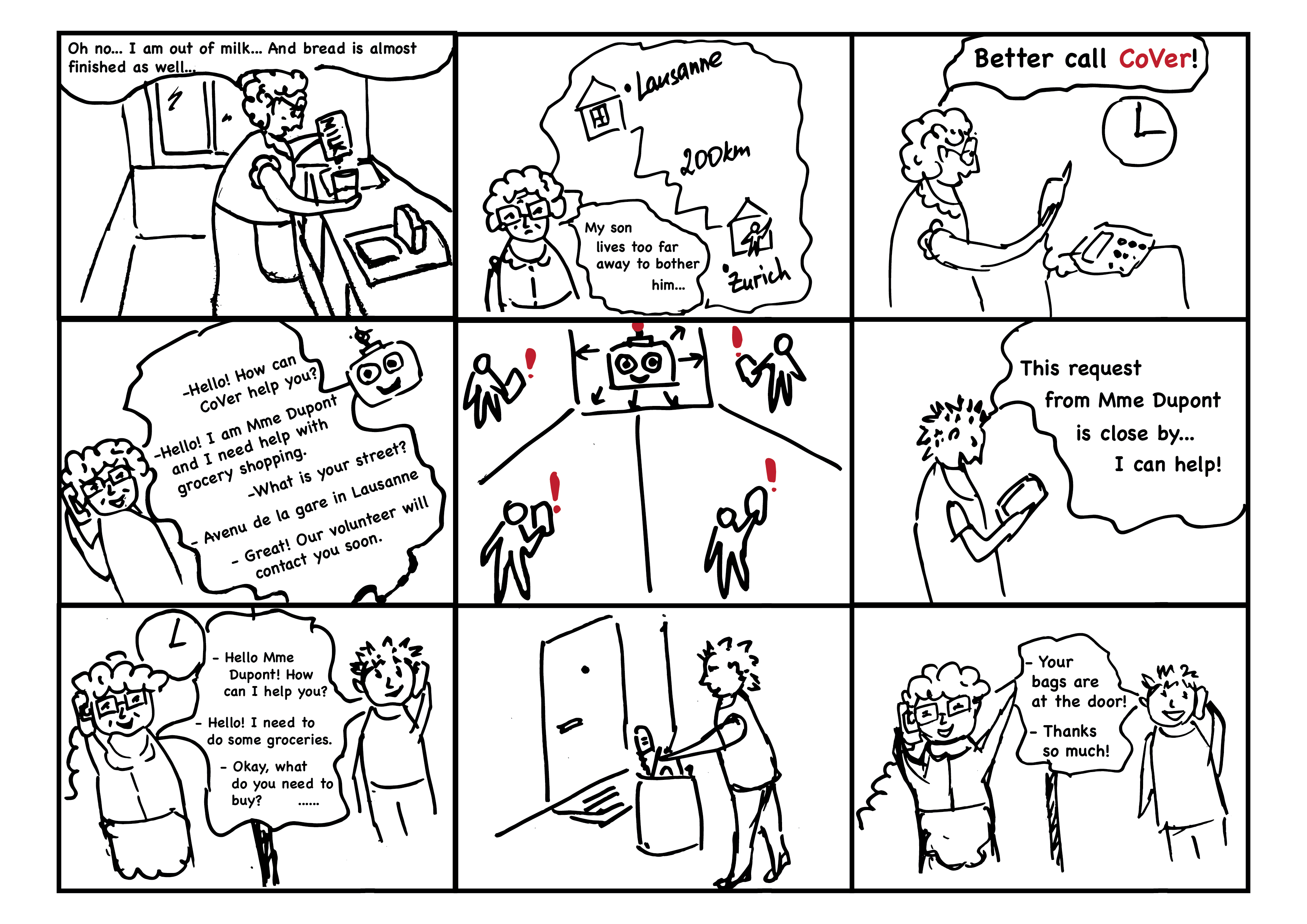
We developed this project within the scope of LauzHack Against COVID-19 hackathon. POV: Elderly and sick people isolated at home need an easy way to connect with volunteers for rapid assistance as online help-seeking is hard while frequent requests to relatives cause social embarrassment. To address the problem and offer protection for the population in need during Covid-19 crisis, we proposed COVER ― a service to connect people with COVid volunteERs via simple and centralized phone calls and sms.
Contact
Residence: Lausanne, Switzerland
Email: ekaterina [DOT] svikhnushina [AT] epfl [DOT] ch